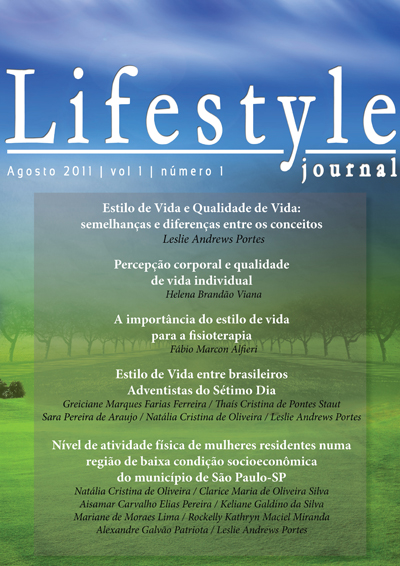
Estilo de vida entre brasileiros Adventistas do Sétimo Dia
DOI:
https://doi.org/10.19141/2237-3756.lifestyle.v1.n1.p17-25Keywords:
Lifestyle, Adventists, Food frequency.Abstract
Objective: To identify the main lifestyle characteristics of Seventh-day
Adventist Church adepts, and to associate them to cardiovascular risk. Method:
We handed out 2.355 questionnaires to people older than 20 years old. 1126 forms (47.8%) were returned, but only 608 (25.8%) filled inclusion criteria. Questionnaires contained 66 questions about demographic and anthropometric aspects, blood pressure, history of personal and family diseases, physical activity, dietetic aspects and intake frequency of 37 referred food products. Results: Semi-vegetarians (SV = 244) and non-vegetarians (NV = 364) did not differ regarding age and practice of physical activities. SV presented lower values (p<0.05) of weight and BMI than NV. Incidence of cardiac disease, arterial blood hypertension, diabetes mellitus and dyslipidemia varied from 2% to 10% and did not differ between SV and NV. SV consumed significantly less sugar, white rice, coffee, candies, margarine and soft drinks when compared to NV (p<0.05). SV consumed significantly more whole foods, almonds, peanuts, cashews, Brazil nuts, fresh fruits, soy milk, texturized vegetal protein and salads than NV (p<0.05). Conclusion: SV presented better lifestyle characteristics than non-vegetarians.
Downloads
References
Fraser GE. Diet, life expectancy, and chronic disease. New York: Oxford University Press, 2003. DOI: https://doi.org/10.1093/oso/9780195113242.001.0001
Armstrong B, Van Merwyk AJ, Coates H. Blood pressure in Seventh-day Adventist vegetarians. Am J Epidemiol, 1977;105:444-9. DOI: https://doi.org/10.1093/oxfordjournals.aje.a112403
Famodu AA, Osiliese O, Makinde YO, Osonuga OA. Blood pressure and blood lipid levels among vegetarian, semi-vegetarian, and non-egetarian
native africans. Cli Bio, 1998;31:545-9. DOI: https://doi.org/10.1016/S0009-9120(98)00067-8
Fønnebø V. Mortality in norwegian seventhday adventists 1962-1986. J Clin Epidemiol, 1992;45:157-67. DOI: https://doi.org/10.1016/0895-4356(92)90008-B
Fønnebø V. The healthy seventh-day adventist lifestyle: what is the norwegian experience? Am J Clin Nutr, 1994;59:1124-9. DOI: https://doi.org/10.1093/ajcn/59.5.1124S
Fønnebø V. The Tromso Heart Study: coronary risk factors in Seventh-Day Adventists. Am J Epidemiol, 1985;122:789-93. DOI: https://doi.org/10.1093/oxfordjournals.aje.a114162
Berkel JE, Waard F. Mortality Pattern and Life Expectancy of Seventh-Day Adventists In The Netherlands. Int J Epidemiol, V.12, P. 455-459, DOI: https://doi.org/10.1093/ije/12.4.455
Mills PK, Beeson WL, Phillips RL, Fraser GE. Cancer incidence among California Seventhday Adventists, 1976-1982. Am J Clin Nutr,1994;58(suppl.):1136S-42S. DOI: https://doi.org/10.1093/ajcn/59.5.1136S
Willett WC. Convergence of philosophy and science: the third international congress on vegetarian nutrition. Am J Clin Nutr,
;70(suppl.):434S-8S.
Fraser GE. Associations between diet and cancer, ischemic heart disease, and all-cause mortality in non-hispanic white california seventh-day adventists. Am J Clin Nutr, 1999;70:532-8. DOI: https://doi.org/10.1093/ajcn/70.3.532s
Brathwaite N, Fraser HS, Modeste N, Broome H, King R. Obesity, diabetes, hypertension, and vegetarian status among Seventh-Day Adventists in Barbados: preliminary results. Ethn Dis Winter,
;13:148-152.
Navarro JC, Prado SC, Guimarães G, Martins MC, Caramelli B. Vegetarians and semivegetarians are less exposed to cardiovascular risk factors. Int J Atheroscler, 2006;1:48-54.
Fraser GE, Shavlik DJ. Ten Years Of Life: Is It A Matter Of Choice? Arch Intern Med, 2001;161:1645-52. DOI: https://doi.org/10.1001/archinte.161.13.1645
Sabaté J. Nut Consumption, vegetarian diets, ischemic heart disease risk, and all-cause mortality: evidence from epidemiologic studies.
Am J Clin Nutr, 1999;70:500-3.
Jacobsen BK, Knutsen SF, Fraser GE. Does high soy milk intake reduce prostate cancer incidence? The Adventist Health Study (United States). Cancer Causes Control, 1998;9:553-7. DOI: https://doi.org/10.1023/A:1008819500080
Fonseca MJ, Chor D, Valente JG. Hábitos alimentares entre funcionários de banco estatal: padrão de consumo alimentar. Cad Saúde Pública, 1999;15:29-40. DOI: https://doi.org/10.1590/S0102-311X1999000100004
Matos AC, Ladeia AM. Assessment of Cardiovascular Risk Factors in a Rural Community in the Brazilian State of Bahia. Arq Bras Cardiol, 2003;81:297-302. DOI: https://doi.org/10.1590/S0066-782X2003001100009
Salaroli LB, Barbosa GC, Mil JG, Molina MC. Prevalência de Síndrome Metabólica em Estudo de Base Populacional, Vitória, ES – Brasil. Arq
Bras Endocrionol Metab, 2007;51:1143-52. DOI: https://doi.org/10.1590/S0004-27302007000700018
Araújo MS, Costa TH, Schmitz BA, Machado LM, Santos WR. Factors associated with overweight and central adiposity in urban workers
covered by the Workers´ Food Program of the Brazilian Amazon Region. Rev Bras Epidemiol, 2010;13:425-33. DOI: https://doi.org/10.1590/S1415-790X2010000300006
Castanho VS, Oliveira LS, Pinheiro HP, Oliveira HC, Faria EC. Sex differences in risk factors for coronary heart disease: a study in a Brazilian population. BMC Public Health, 2001;1:3. DOI: https://doi.org/10.1186/1471-2458-1-3
Jardim PC, Gondim MR, Monego ET, Moreira HG, Vitorino PV, Souza WK, Scala LC. High blood pressure and some risk factors in Brazilian
capital. Arq Bras Cardiol, 2007;88:398-403.
Sá NN, Moura EC. Fatores associados à carga de doenças da síndrome metabólica entre adultos brasileiros. Cad Saúde Pública, 2010;26:1853-62. DOI: https://doi.org/10.1590/S0102-311X2010000900018
Fernandes RA, Christofaro DG, Casonato J, Rosa CS, Costa FF, Freitas Júnior IF, et al. Leisure time behaviors: prevalence, correlates and associations with overweight in Brazilian adults. A crossectional
analysis. Rev Med Chile, 2010;138:29-35.
Nascente FM, Jardim PC, Peixoto MR, Monego ET, Moreira HG, Vitorino PV, et al. Arterial Hypertension and its Correlation with Some
Risk Factors in a Small Brazilian Town. Arq Bras Cardiol, 2010;95:502-9.
Gus I, Fischmann A, Medina C. Prevalence of Risk Factors for Coronary Artery Disease in the Brazilian State of Rio Grande do Sul. Arq Bras Cardiol, 2002;78:484-90. DOI: https://doi.org/10.1590/S0066-782X2002000500005
Reichert FF, Azevedo MR, Breier A, Gerage AM. Physical activity and prevalence of hypertension in a population-based sample of Brazilian adults and elderly. Prev Med, 2009;49:200-4. DOI: https://doi.org/10.1016/j.ypmed.2009.06.009
Gigante DP, Moura EC, Sardinha LM. Prevalence of overweight and obesity and associated factors, Brazil, 2006. Rev Saúde Pública, 2009;43(supl.):1-7. DOI: https://doi.org/10.1590/S0034-89102009000900011
Cipullo JP, Martin JF, Ciorlia LA, Godoy MR, Cação JC, Loureiro AA, et al. Hypertension prevalence and risk factors in a Brazilian urban
population. Arq Bras Cardiol, 2010;94:488-94.
Lyra R, Silva RS, Montenegro Jr. RM, Matos MV, Cézar NJ, da Silva LM. Arq Bras Endocrinol Metab, 2010;54:560-6. DOI: https://doi.org/10.1590/S0004-27302010000600009
Cassani RS, Nobre F, Pazin Filho A, Schmidt A. Prevalence of cardiovascular risk factors in a population of Brazilian industry workers. Arq Bras Cardiol, 2009;92:15-21. DOI: https://doi.org/10.1590/S0066-782X2009000100004
Franco GP, Scala LC, Alves CJ, França GV, Cassanelli T, Jardim PC. Metabolic syndrome in patients with high blood pressure in Cuiabá
– Mato Grosso State: prevalence and associated factors. Arq Bras Cardiol, 2009;92:437-42.
Pitanga FJ, Lessa I. Indicadores antropométricos de obesidade como instrument de triage para risco coronariano elevado em adultos na Cidade de Salvador – Bahia. Arq Bras Cardiol, 2005;85:26- 31. DOI: https://doi.org/10.1590/S0066-782X2005001400006
Longo GZ, Neves J, Luciano VM, Peres MA. Prevalence of high blood pressure levels and associated factors among adults in Southern
Brazil. Arq Bras Cardiol, 2009;93:360-6.
Souza LJ, Souto Filho JT, Dousa TF, Reis AF, Gicovate Neto C, Bastos DA, et al. Prevalence of dyslipidemia and risk factors in Campos dos Goytacazes, in the Brazilian State of Rio de Janeiro. Arq Bras Cardiol, 2003;81:257-64. DOI: https://doi.org/10.1590/S0066-782X2003001100005
Dalpino FB, Sodré FL, Faria EC. The use of a hospital laboratory cohort to estimate the prevalence of dyslipidemia in an adult Brazilian
population. Clinica Chimica Acta, 2006;367:189-191. DOI: https://doi.org/10.1016/j.cca.2005.12.001
Leite-Cavalcanti C, Rodrigues-Gonçalves MC, Rios-Asciutti LS, Leite-Cavalcanti A. Prevalência de doenças crônicas e estado nutricional em um grupo de idosos brasileiros. Rev Salud Pública, 2009;11:865-77. DOI: https://doi.org/10.1590/S0124-00642009000600003
Siqueira AF, Harima HA, Osiro K, Hirai AT, Gimeno SG, Ferreira SR, et al. Distúrbios no perfil lipídico são altamente prevalentes em população Nipo-Brasileira. Arq Bras Endocrionol Metab, 2008;52:40-6. DOI: https://doi.org/10.1590/S0004-27302008000100007
Pereira JC, Barreto SM, Passos VM. Perfil de risco cardiovascular e autoavaliação da saúde no Brasil: estudo de base populacional. Rev Panam Salud Pública, 2009;25:491-8. DOI: https://doi.org/10.1590/S1020-49892009000600004
Passos VM, Barreto SM, Diniz LM, Lima-Costa MF. Type 2 diabetes: prevalence and associated factors in a Brazilian community – the Bambuí
health and aging study. Sao Paulo Med J, 2005;123:66-71. DOI: https://doi.org/10.1590/S1516-31802005000200007
Fraser GE, Strahan TM, Sabate J, Beeson WL, Kissinger D. Effects of Traditional coronary risk factors on rates of incident coronary events in a
low-risk population the Adventist Health Study. Circulation, 1992;86:406-13. DOI: https://doi.org/10.1161/01.CIR.86.2.406
Hallal PC, Matsudo SM, Matsudo VK, Araújo TL, Andrade DR, Bertoldi AD. Physical activity in adults from two Brazilian areas: similarities and
differences. Cad Saúde Pública, 2005;21:573-80. DOI: https://doi.org/10.1590/S0102-311X2005000200024
Quadros TM, Petroski EL, Santos-Silva DA, Pinheiro-Gordia A. The prevalence of physical inactivity amongst Brazilian university students:
its association with sociodemographic variables. Rev Salud Publica, 2009;11:724-33. DOI: https://doi.org/10.1590/S0124-00642009000500005
Downloads
Published
How to Cite
Issue
Section
License
Copyright (c) 2014 Life Style

This work is licensed under a Creative Commons Attribution 4.0 International License.
The authors retain copyright over their published works and grant the Journal of Interdisciplinary Lifestyle Studies the right of first publication.
Articles are published under the Creative Commons Attribution 4.0 International License (CC BY 4.0). This license permits third parties to share, copy, distribute, reproduce, adapt, transform, and create derivative works from the material for any purpose, including commercial purposes, provided that the following conditions are met:
- appropriate credit is given to the authors;
- the original source of publication is acknowledged;
- a link to the license is provided;
- any changes made to the content are clearly indicated;
- no suggestion is made that the authors or the journal endorse the use of the material.
The license does not waive the authors’ moral rights and does not authorize the use of third-party materials that are not covered by the article’s license.
Authors may enter into additional agreements for the non-exclusive distribution of the published version, including deposit in institutional repositories, publication in books, dissemination on personal websites, and use for academic purposes, provided that the original publication in the journal is properly acknowledged.
By submitting and publishing the manuscript, the authors declare that they have the necessary rights to license the content and that any images, tables, instruments, datasets, or other third-party materials have been used with appropriate permission or in accordance with applicable legal limitations.
 This work is licensed under Creative Commons Attribution 4.0 International